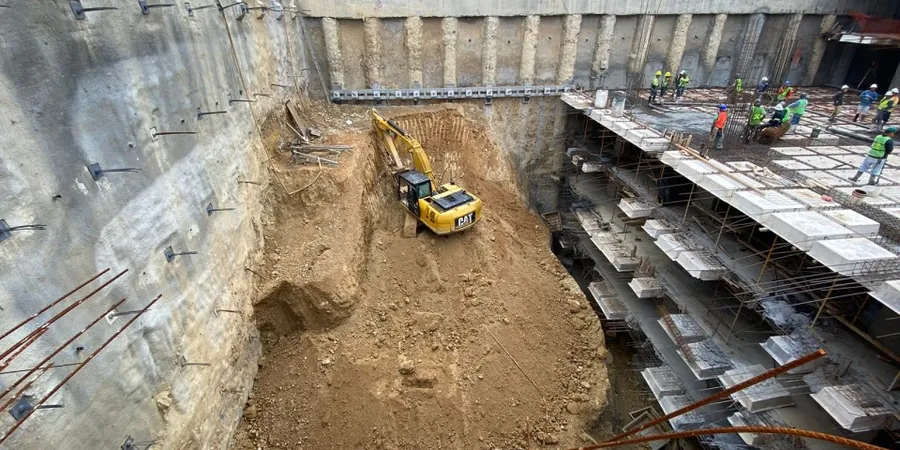
A mixed-use tower on 16th Street Mall hit groundwater just 18 feet down, right at the contact between man-made fill and the underlying claystone. The contractor had planned soldier piles and lagging, but the combination of saturated ground and proximity to a century-old masonry building demanded a faster, more rigid system. In Denver, deep excavations rarely follow the textbook. The Denver Basin’s layered stratigraphy — from Pleistocene gravels to the expansive Pierre Shale — creates abrupt transitions in stiffness and permeability that can blindside a crew if the pre-construction investigation skips depth-specific data. Our team stepped in with a performance-based design, correlating CPT pore pressure dissipation profiles with laboratory swell-consolidation curves to size walers, struts, and tiebacks that would limit lateral movement to under half an inch at the property line.
In the Denver Basin, the difference between a dry excavation and a costly remediation is often a single sand lens that the borings missed.
Methodology and scope
Local considerations
The rig set up on Stout Street was a Klemm KR 909-3, compact enough to maneuver between the light rail catenary poles and the building overhang, yet capable of drilling an 8-inch cased hole through cobble-rich alluvium in under an hour. In Denver’s urban core, the biggest threat is not the excavation itself but the legacy infrastructure surrounding it: ungrouted brick manholes from the 1920s, shallow gas lines relocated three times, and neighboring foundations that predate modern reinforcement codes. A sudden loss of groundwater during a summer thunderstorm — when the South Platte tributaries rise and infiltrate the granular terrace deposits — can generate differential settlement exceeding 0.2 inches within a single block. We mitigate this by designing the support system for a 100-year storm event and specifying a contingency depressurization well ring outside the excavation perimeter, activated only if vibrating-wire piezometers show a sustained head increase of more than 2 feet over the baseline established during the pre-construction monitoring period.
Applicable standards
IBC Chapter 18 – Soils and Foundations (2021 edition, adopted by City and County of Denver), FHWA-NHI-05-043 – Soil and Rock Nail Walls, AASHTO LRFD Bridge Design Specifications, 9th Ed. – Ground Anchor Design, ASTM D1586-18 – Standard Penetration Test (SPT), ASTM D2487-17 – Unified Soil Classification System
Associated technical services
Shoring Design and Peer Review
Full preparation of construction documents for soldier pile, secant, and soil nail walls, including internal bracing layouts, waler sizing, and connection details. We also perform independent peer reviews for design-build teams, checking global factors of safety against basal heave, rotational slip, and hydraulic piping under Denver’s seasonal groundwater conditions.
Excavation Monitoring and Trigger-Action Plans
Deployment of inclinometers, optical survey targets, and piezometers around the excavation perimeter, tied to a site-specific trigger-action response plan that defines green, yellow, and red alert thresholds for lateral movement, settlement, and vibration. This plan is coordinated with the City of Denver’s right-of-way inspection division before shoring begins.
Typical parameters
Frequently asked questions
What is the typical cost range for a geotechnical deep excavation design in Denver?
For a medium-complexity urban excavation between 20 and 40 feet deep, the complete design package — including earth pressure analysis, shoring wall structural calculations, dewatering plan, and a monitoring specification — usually falls between US$2,190 and US$9,500. The final figure depends on the number of retained soil types, the proximity of adjacent structures, and whether groundwater control requires a detailed 3D seepage model.
How does the expansive Pierre Shale affect temporary excavation stability?
Pierre Shale can lose significant strength when exposed to air and moisture. Within a few days of unloading, the claystone undergoes stress relief cracking, allowing water to infiltrate and reduce its unconfined compressive strength by up to 40%. Our designs account for this by specifying a shotcrete or membrane seal coat on the exposed face within 48 hours of excavation, and we base the long-term strength parameters on saturated, remolded triaxial tests rather than the peak values from fresh cores.
Do I need a separate dewatering permit for a deep excavation in Denver?
Yes. The City and County of Denver requires a dewatering discharge permit if you expect to extract more than 10,000 gallons per day. Our design report includes a hydrogeologic assessment that estimates inflow rates using the Modified Theis solution for confined aquifers and provides the water quality data needed for the discharge application. We also coordinate with Denver Wastewater Management to confirm that the receiving storm sewer has adequate capacity.
What vibration limits apply during shoring installation near historic masonry buildings?
For unreinforced masonry structures in the Lower Downtown Historic District, we typically adopt a peak particle velocity limit of 0.25 inches per second in the 10 to 30 Hz frequency band, which is more conservative than the standard OSMRE 0.5 in/s guideline. Our monitoring plan uses triaxial geophones mounted on the nearest foundation wall, and if the threshold is approached during drilling or driving, we switch to a lower-energy installation method such as oscillator-rotated casing or pre-augering.