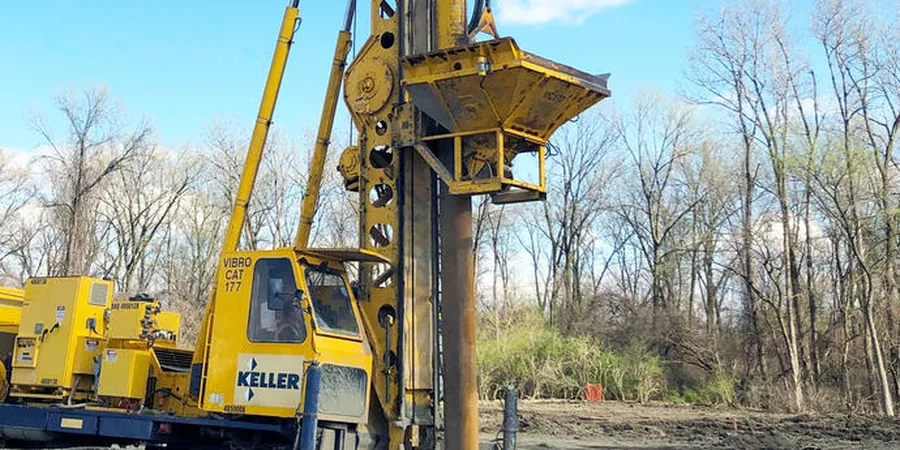
A common mistake we see with Denver metro projects is assuming standard compaction can handle the loose, wind-deposited sands along the High Line Canal or the Cherry Creek corridor. You compact the top few feet, pass a proof roll, and everything looks solid. Six months later, settlement cracks trace through the slab because the underlying 20 feet of loose alluvium never got the deep treatment it needed. Vibrocompaction design addresses exactly this condition, rearranging granular particles into a denser state through depth-controlled vibration. In a city built on a complex mix of Pleistocene gravels, Denver Formation claystone, and recent floodplain deposits, this technique becomes essential for warehouses, tanks, and embankments that cannot tolerate differential movement. We often pair this with an SPT drilling program to verify post-treatment density, particularly where groundwater fluctuates near the Platte River.
Vibrocompaction can increase the SPT N-value of loose Denver sands from single digits to 25 or higher, eliminating the need for overexcavation.
Methodology and scope
Local considerations
Denver's semi-arid climate creates a particular challenge for vibrocompaction: the upper 3 to 5 feet of soil are often dry and desiccated, which reduces the effectiveness of vibration energy transfer. When the ground lacks moisture, capillary forces hold grains together, and the vibrator can expend energy breaking these bonds rather than rearranging particles. We counteract this by pre-wetting the treatment zone through the probe's water jets or by scheduling work after monsoon season when soil moisture is naturally higher. Another risk along the Front Range is encountering cobbles and boulders within the alluvium; these can deflect the probe and create untreated zones. Refusal at shallow depth in these areas may necessitate switching to stone columns or rigid inclusions at localized spots. The expansive claystone bedrock beneath Denver also demands caution: vibrocompaction must terminate above the weathered claystone interface to avoid creating pathways for water infiltration that could trigger heave beneath the improved mass.
Applicable standards
ASTM D1586-18 Standard Test Method for Standard Penetration Test (SPT) and Split-Barrel Sampling of Soils, ASTM D5778-20 Standard Test Method for Electronic Friction Cone and Piezocone Penetration Testing of Soils, IBC 2021 Chapter 18 Soils and Foundations (Section 1806 on Presumptive Load-Bearing Values post-improvement)
Associated technical services
Feasibility and Desktop Study
We review existing logs, groundwater data, and local geology maps from the Colorado Geological Survey to determine if vibrocompaction is suited to the site's grain-size distribution and depth of loose material.
Trial Program Design and Analysis
A full-scale test section is designed with variable spacing and energy settings. We instrument the vibrator and analyze real-time compaction data alongside pre- and post-treatment CPT soundings to lock in production parameters.
Production Monitoring and Acceptance Testing
During production, we track ammeter records, settlement per pass, and probe penetration rate. Acceptance is based on statistical analysis of post-treatment SPT borings correlated to the specified relative density target.
Typical parameters
Frequently asked questions
What types of Denver soil conditions are ideal for vibrocompaction?
Vibrocompaction works best in clean, granular soils with a fines content below 15 percent, which describes many of the loose alluvial and aeolian deposits found east of downtown Denver and along the South Platte River floodplain. If the soil contains more than 20 percent silt or clay, the vibration energy cannot effectively rearrange particles, and alternative methods like stone columns or rigid inclusions should be evaluated. A grain-size analysis from an ASTM D422 test gives us the quickest answer on suitability.
How much does vibrocompaction design cost for a typical Denver project?
For a standalone design package covering feasibility analysis, trial program specifications, and acceptance criteria, budgets in the Denver area generally range from US$1,490 for smaller single-building pads to around US$4,550 for larger multi-acre developments requiring phased treatment and comprehensive statistical verification plans.
How long after vibrocompaction can we begin foundation construction?
Foundation work can begin immediately after acceptance testing confirms the target relative density has been achieved, because vibrocompaction does not introduce water or curing time into the ground the way grouting or chemical stabilization does. On most Denver sites, the verification borings are completed within 3 to 5 days of finishing the compaction passes, and construction can proceed the same week.