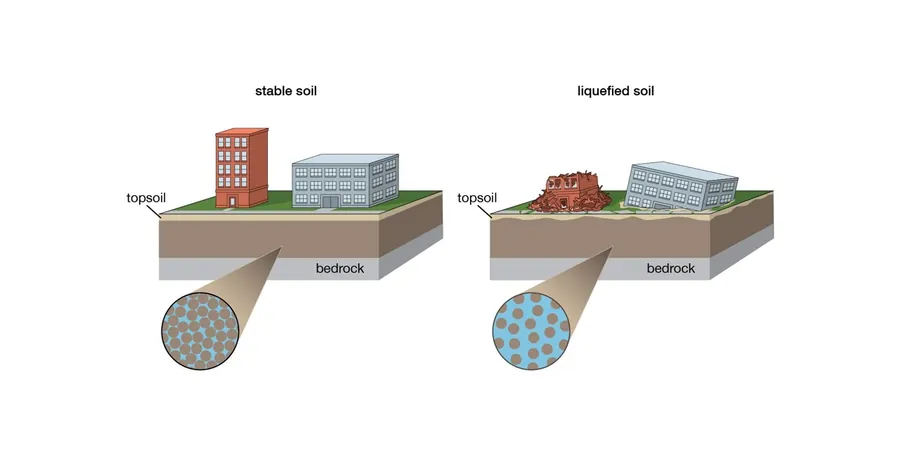
Denver's position east of the Rocky Mountain Front means the subsurface isn't just weathered bedrock, it often includes loose alluvial sands and a shallow groundwater table along the South Platte River and its tributaries. When you combine these saturated granular soils with the city's moderate but real seismic hazard, the need for a detailed soil liquefaction analysis becomes clear. We've run SPT drilling campaigns across the metro area, from Cherry Creek to Commerce City, and the variability is striking. One site might hit dense gravels at 15 feet, while another just half a mile away shows clean, loose sand to 30 feet. Our team uses these field data alongside lab cyclic testing to quantify the factor of safety against liquefaction, ensuring your foundation design meets the site-specific ground motion requirements of the 2024 IBC and ASCE 7-22.
Liquefaction in Denver isn't theoretical. Loose Holocene sands along the South Platte corridor can lose strength under the design earthquake, making site-specific analysis non-negotiable.
Methodology and scope
Local considerations
Denver sits at exactly 5,280 feet, the Mile High City, but the real risk for geotechnical engineers lies in the sedimentary fill below that elevation. The mapped Quaternary alluvium along the South Platte River and Sand Creek corridors contains water-saturated sand lenses that are prime candidates for cyclic mobility. A soil liquefaction analysis that overlooks the potential for lateral spreading near stream banks or bridge abutments can lead to foundation distress that appears years after construction, typically following a moderate earthquake on the nearby Cheraw Fault or a distant event amplified by the deep Denver Basin sediments. The cost of ignoring this hazard isn't just structural; it's the prolonged litigation and retrofit expenses that follow. Our reports explicitly address the IBC Section 1803 requirement for seismic ground failure analysis when Site Class F conditions are triggered by liquefaction potential.
Applicable standards
ASCE 7-22 (Minimum Design Loads, Chapter 11 Seismic), IBC 2024 (International Building Code, Section 1803 Geotechnical Investigations), ASTM D1586-18 (Standard Test Method for Standard Penetration Test), ASTM D5778-20 (Standard Test Method for Electronic Friction Cone and Piezocone Penetration Testing of Soils), ASTM D5311/D5311M-13 (Standard Test Method for Load Controlled Cyclic Triaxial Strength of Soil)
Associated technical services
SPT-Based Liquefaction Screening
Field drilling with energy-calibrated SPT hammers per ASTM D1586, paired with split-spoon sampling for fines content and plasticity index determination. We deliver depth-specific factor of safety calculations using the NCEER simplified procedure.
Cyclic Laboratory Testing Program
Stress-controlled cyclic triaxial tests on undisturbed or reconstituted specimens to measure the cyclic resistance ratio directly. Essential for critical infrastructure where settlement tolerance is near zero.
Typical parameters
Frequently asked questions
What seismic parameters should be used for a liquefaction analysis in Denver?
We use the ASCE 7-22 Risk-Targeted Maximum Considered Earthquake ground motion values, adjusted for site class. For Denver, the peak ground acceleration typically ranges from 0.10g to 0.16g depending on the exact location, and the analysis applies a magnitude scaling factor appropriate for the Front Range's seismic sources, usually a moment magnitude around 6.5 to 7.0 for the deaggregated scenario.
How much does a soil liquefaction analysis cost in the Denver area?
For a typical commercial lot in the Denver metro, a complete liquefaction assessment combining field SPT drilling and laboratory testing runs between US$2,640 and US$4,430. The range depends on the number of borings, depth to groundwater, and whether cyclic triaxial testing is required for the project.
Does Denver County require a liquefaction study for building permits?
The City and County of Denver enforces the IBC, which mandates a geotechnical investigation addressing seismic ground failure when the site class is E or F. If the subsurface exploration reveals saturated, loose sands and a shallow water table, a liquefaction analysis becomes a required submittal for the foundation permit, and the reviewer will look for the factor of safety calculation in the report.
What is the difference between a screening-level and a detailed liquefaction analysis?
A screening-level analysis uses SPT blow counts and grain-size data to estimate the cyclic resistance ratio. It is sufficient for low-rise structures on spread footings. A detailed analysis incorporates site-specific ground response modeling and cyclic lab testing to refine the settlement and lateral spreading predictions, which is what we recommend for bridges, high-rise buildings, and critical facilities in the Platte River floodplain.