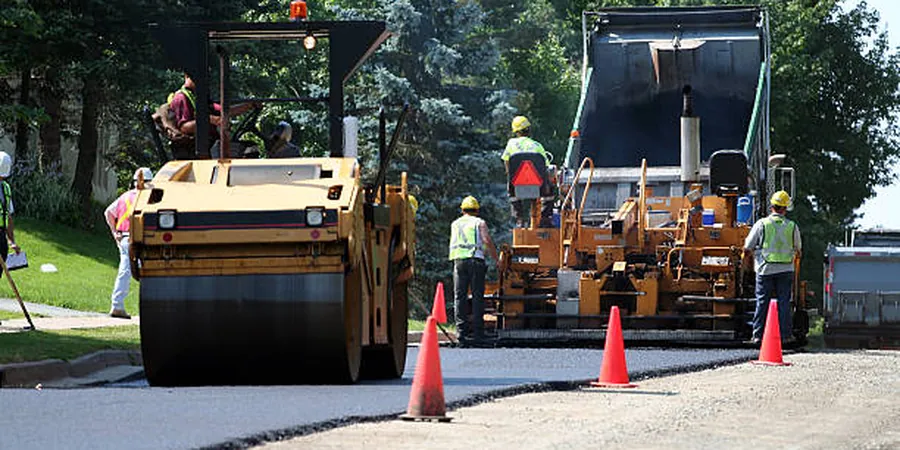
A Caterpillar AP1055F paver laying a 2-inch HMA lift on Colfax Avenue tells you more about Denver pavement needs than any textbook. The machine’s weight, the roller pattern behind it, and the way the mat compacts under a 4,200-foot elevation sun all depend on what’s underneath: a subgrade that can swing from stiff Denver Formation claystone to swelling Pierre Shale within half a mile. We design flexible pavement sections starting with that subgrade—sampled, classified, and tested for resilient modulus. Where CBR values drop below 3 in the eastern plains corridors, we work the base course thickness and HMA binder grade to prevent rutting before the first winter freeze-thaw cycle hits. For projects near the South Platte River, where groundwater sits shallow, a grain-size analysis of the subbase material becomes essential to verify drainage capacity under repeated traffic loads.
Denver’s 5,280-foot elevation and 170 annual freeze-thaw cycles demand a flexible pavement section designed from the subgrade up, not copied from a sea-level standard.
Methodology and scope
Local considerations
The most expensive mistake we see in Denver flexible pavement is placing a standard section on untreated expansive subgrade and walking away. That section will fail within three seasons—not from traffic, but from differential heave that cracks the asphalt in a classic alligator pattern radiating from the centerline. A Denver County arterial rebuilt in 2017 required full-depth reclamation after two winters because the original design ignored a 40-foot band of Pierre Shale with swell potential exceeding 5 percent. The repair cost triple the initial pavement budget. Another recurring failure: under-designed base drainage. Denver’s spring snowmelt saturates the upper subgrade; without a daylighted permeable base or edge drains, the pore pressure under cyclic loading strips the HMA from the aggregate. We specify internal drainage layers and verify with permeability testing before signing off. At 5,280 feet, the combination of UV, freeze-thaw, and expansive clays punishes generic designs relentlessly.
Applicable standards
AASHTO 1993/1998 Pavement Design Guide, CDOT M&P Standard Specifications (current edition), AASHTO M320 (Performance-Graded Asphalt Binder), ASTM D1883 (CBR of Laboratory-Compacted Soils), AASHTO T-307 (Resilient Modulus)
Associated technical services
Subgrade Evaluation & Stabilization Design
Sampling, Atterberg limits, and CBR testing of Denver Basin claystones and alluvial soils. Lime and cement stabilization mix designs for expansive subgrades with swell potential up to 8 percent.
Pavement Structural Design (AASHTO & MEPDG)
Layered elastic analysis using CDOT traffic spectra. We produce SN-based and mechanistic-empirical designs for arterials, collectors, and industrial pavements across the Front Range.
Asphalt Mix Verification & Field Support
HMA volumetric design review, PG binder grade selection for Denver’s altitude, and field density correlation using nuclear gauge and core calibration during placement.
Typical parameters
Frequently asked questions
How much does a flexible pavement design cost for a Denver project?
For a typical Denver commercial or municipal project, flexible pavement design fees run between US$1,560 and US$4,480, depending on the traffic analysis level, the number of soil units evaluated, and whether we are producing a full MEPDG-calibrated section or an AASHTO SN-based design. A small parking lot falls at the lower end; a Denver arterial with CDOT review requirements falls at the upper end.
What PG binder grade do you specify for Denver’s altitude?
For most Denver metro projects we specify PG 58-28 or PG 64-22, depending on traffic speed and volume. The low-temperature grade (-28°C) is non-negotiable given Denver’s winter lows; the high-temperature grade shifts to 64 for slow-moving or standing traffic where rutting risk increases. We follow AASHTO M320 and CDOT’s current binder selection map.
How do expansive clays affect flexible pavement design in the Denver Basin?
Expansive clays in the Denver Formation and Pierre Shale can produce swell pressures exceeding 10,000 psf with volume changes of 5 to 8 percent under moisture fluctuation. Without stabilization, these soils heave differentially and crack the asphalt within two to three freeze-thaw cycles. We design lime or cement treatment to reduce plasticity index below 10 and specify a minimum stabilized depth, typically 12 inches, verified by post-treatment Atterberg limits and pH testing on site.