In Denver, the transition between surficial sands and the underlying bedrock often masks a critical layer many contractors overlook: the expansive Denver Blue Clay. We have analyzed cores from the Golden fault zone to the Platte River floodplain, and the variability in cohesion and friction angle can be staggering across just a few blocks. A standard penetration test gives you blow counts, but for deep excavations or retaining structures near Cherry Creek, you need the stress path data that only a consolidated-undrained triaxial test provides. This is where our laboratory steps in: we apply confining pressures up to 200 psi to replicate overburden conditions at 30 or 60 feet, delivering the drained and undrained parameters your structural engineer actually needs. Before committing to a mat foundation design, pairing our triaxial data with a detailed grain size analysis can flag silty layers that compromise the assumed drainage conditions during the test.
A single consolidated-undrained test on Denver Blue Clay can differentiate between a stable 20-foot excavation and a costly shoring retrofit.
Methodology and scope
Local considerations
Denver's building code references IBC Chapter 18, which requires a thorough geotechnical investigation for structures in Seismic Design Category B or higher. While Denver sits in a moderate seismic zone, the presence of the Pierre Shale — an overconsolidated claystone — introduces a risk of time-dependent strength loss when it is unloaded during excavation. We have seen triaxial peak strengths on Pierre Shale specimens that degrade by 30% within two weeks of exposure to air humidity in the lab, a phenomenon that directly impacts the design bearing pressure of drilled shafts socketed into this formation. Ignoring the effective stress envelope and relying solely on unconfined compressive strength can lead to a dangerous overestimation of short-term stability. Furthermore, the expansive nature of the Denver Blue Clay means that the drained friction angle alone is insufficient; the cohesion intercept at low confining stresses is the parameter controlling near-surface heel failure in cantilever retaining walls. Our tests isolate these variables so the structural design accounts for the true undrained shear strength at the depth of the proposed footing.
Applicable standards
ASTM D4767-11: Standard Test Method for Consolidated Undrained Triaxial Compression Test for Cohesive Soils, ASTM D2850-15: Standard Test Method for Unconsolidated-Undrained Triaxial Compression Test on Cohesive Soils, ASTM D7181-20: Method for Consolidated Drained Triaxial Compression Test for Soils, IBC 2024 Section 1803: Geotechnical Investigations, USBR Design Standards No. 13: Embankment Dams
Associated technical services
Consolidated-Undrained (CU) Testing with Pore Pressure
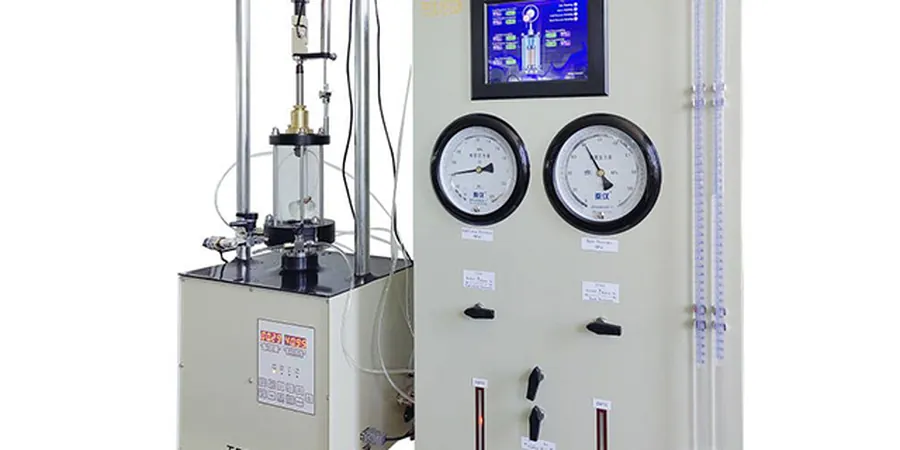
Designed for the Denver Blue Clay and Pierre Shale, this test measures effective stress parameters (c' and φ') by shearing saturated specimens while recording excess pore pressure. We apply backpressure saturation until B-values exceed 0.95, then consolidate the sample to the estimated in-situ effective stress before shear. This method provides the undrained shear strength profile for short-term excavation stability and the drained envelope for long-term bearing capacity calculations.
Unconsolidated-Undrained (UU) and Drained (CD) Programs
For coarse-grained soils from the Castle Rock conglomerate or compacted structural fill, we run CD triaxial tests that measure the true drained friction angle, capturing the dilatancy effect that increases shear resistance. For emergency assessments or rapid shoring design in saturated silts near the Platte River, the UU test provides a quick undrained cohesion value within 24 hours, allowing the contractor to proceed with the excavation support plan without delay.
Typical parameters
Frequently asked questions
What does a triaxial test cost in Denver for a typical commercial building project?
For a standard program involving three CU triaxial tests on Denver Blue Clay specimens, the fee typically ranges from US$1,660 to US$2,910, depending on confining stress levels and the number of consolidation stages. This includes backpressure saturation, shear to 15% strain, and the complete report with p-q diagrams and Mohr-Coulomb envelopes. Testing on hard Pierre Shale requires different specimen preparation and higher confining pressures, which falls at the upper end of that range.
How do you ensure the triaxial results are representative of the actual ground conditions in Denver?
We minimize sample disturbance by trimming specimens from 4-inch Shelby tubes taken with a fixed-piston sampler, then we run P-wave velocity checks before the test to confirm the soil structure is intact. For the Denver Blue Clay, we also replicate the in-situ stress history by using anisotropic consolidation if the client provides K_0 estimates from field geophysics. The strain rate during shear is calculated per ASTM D4767 based on the consolidation coefficient, so we do not generate artificial excess pore pressures that would distort the effective stress envelope.
Can you test gravelly soils from the Castle Rock formation in a triaxial cell?
Yes, for clast-supported conglomerates with grain sizes up to about 0.75 inches, we prepare 4-inch diameter specimens that respect the maximum particle size ratio of 1/6 of the specimen diameter. We run consolidated-drained tests per ASTM D7181, shearing slowly enough to dissipate pore pressures and measuring volumetric strain directly with on-sample transducers. This captures the dilative peak strength that governs the design of spread footings on these dense granular deposits.