Denver sits at exactly 5,280 feet, but the real story for structural engineers lies in the variable sediments of the Denver Basin below. The city's unique geology, shaped by the South Platte River and ancient alluvial fans, demands precise seismic site classification. The 1882 earthquake near the Front Range, though moderate, reminds us that intraplate seismicity is a design reality here. Our laboratory team runs MASW surveys using 24-channel seismographs to capture VS30 values directly, not just correlate them from blow counts. When the subsurface includes the problematic swelling claystone of the Denver Formation, a direct seismic refraction profile often helps delineate the weathered bedrock interface before finalizing the shear wave model.
A direct MASW survey in Denver's Cherry Creek alluvium revealed a VS30 of 285 m/s, reclassifying the site from the default Site D and saving the project significant foundation cost.
Methodology and scope
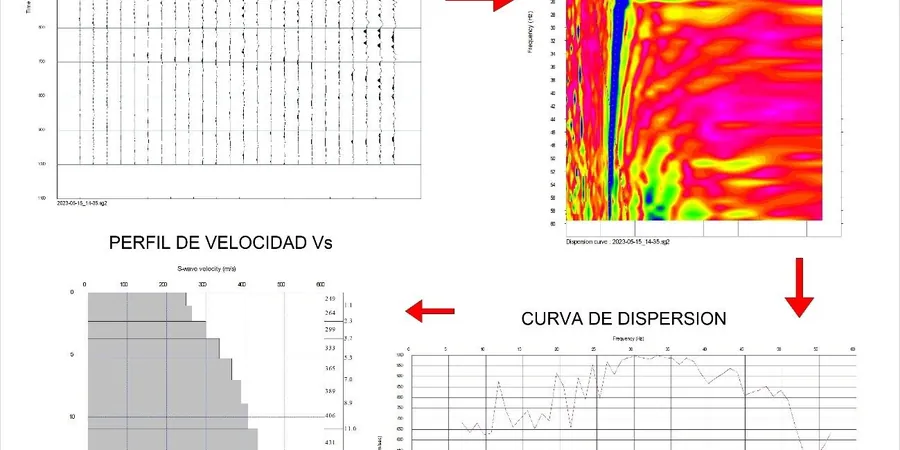
- Source energy optimization using a 10 kg sledgehammer with strike plate to achieve signal coherence below 10 Hz
- Surface wave dispersion analysis with overtone inspection to isolate fundamental mode, critical in layered soils
- 1D shear wave velocity inversion with damping parameters calibrated against local lithology logs
Local considerations
The contrast between Denver's eastern plains and the foothills to the west is stark when it comes to seismic response. A site near Golden on shallow, stiff bedrock might show a VS30 above 760 m/s, while a downtown Denver location on deep alluvial sands could fall into Site Class D or even E if a soft clay layer is present. Applying a single site class across a large parcel without spatial sampling is the most common error we see. The ASCE 7-22 multi-period site amplification factors mean that getting VS30 wrong by just 20 m/s can shift the entire design spectrum. In the Denver Basin, paleochannel deposits of loose sand interbedded with stiff clay create velocity inversions that fool simple regression models. Only a proper dispersion curve inversion, with fundamental mode tracking, catches these low-velocity zones.
Applicable standards
ASCE 7-22 Minimum Design Loads and Associated Criteria for Buildings and Other Structures, IBC 2021 Section 1613 (Earthquake Loads) and Chapter 20 (Site Classification), ASTM D7400-17 Standard Test Methods for Downhole Seismic Testing (MASW Section), NEHRP Recommended Seismic Provisions for New Buildings (FEMA P-1050)
Associated technical services
VS30 Site Classification
Full 24-channel survey with dispersion analysis and inversion. Delivers a signed report with NEHRP Site Class (A-F), VS30 map, and depth-averaged VS profiles for use in structural design per ASCE 7.
Combined MASW + SPT Campaign
Integrated drilling and surface wave testing. SPT blow counts from our SPT drilling crew provide direct soil classification, while MASW supplies the continuous velocity model. Ideal for liquefaction assessments where both VS and SPT-based triggering methods are required.
Seismic Refraction Tomography
For sites where bedrock depth exceeds 30 m or lateral heterogeneity is expected. Our seismic refraction service provides P-wave velocity tomograms that complement MASW shear wave profiles, improving the interpretation of the bedrock surface.
Typical parameters
Frequently asked questions
What is the typical turnaround time for a MASW survey report in Denver?
Fieldwork for a single VS30 profile typically takes one day. Processing, inversion, and reporting require an additional 3 to 5 business days. If the project requires correlation with concurrent drilling data, we coordinate directly with the drilling subcontractor to avoid schedule conflicts.
How much does a MASW / VS30 survey cost in the Denver metro area?
For a standard 24-channel array with report, the cost ranges from US$1,760 to US$2,840 depending on site access, array length, and the number of source impacts required for good signal-to-noise ratio. Multi-line surveys for site-wide VS30 mapping are quoted per linear meter.
Can MASW be performed on a site with heavy traffic noise?
Yes, though it requires longer record stacking and careful filtering. We use triggered vertical stacking to suppress random noise from traffic. In extreme cases, we schedule the survey during low-traffic hours. The fundamental mode dispersion curve can usually be extracted even with moderate ambient noise if the active source energy is sufficient.
Does Denver's expansive claystone affect the shear wave velocity measurement?
The Denver Formation's claystone has a characteristic VS range of 400 to 700 m/s when intact, but this drops significantly in weathered zones. Our inversion process specifically models these low-velocity near-surface layers, which are critical for site amplification calculations. We often see a velocity inversion at the alluvium-claystone contact that must be resolved in the dispersion image.